
Gravel & Landscape Material Calculators
Estimate cubic yards, US short tons, cubic feet, and material costs for gravel, crushed stone, river rock, pea gravel, and road base projects. Includes customizable ordering adjustments.
Complete Landscape Material Calculator Directory
Choose a specialized calculator below tailored to your specific project geometry, stone gradation, and purchasing unit:
Core Volume & Weight Converters
Gravel Calculator
General-purpose calculator converting length, width, and depth into cubic yards, tons, and bags.
Gravel Tons Calculator
Converts dimensions or known cubic yards directly into US short tons (2,000 lbs) for bulk ordering.
Gravel Cubic Yard Calculator
Converts feet, inches, meters, or centimeters into exact cubic yards (yd³) and cubic feet (ft³).
Material-Specific Calculators
Driveway Gravel Calculator
Calculates dense-grade aggregate, crusher run, and top dressing for single, double, and rural driveways.
Pea Gravel Calculator
Calculates 1/4" to 3/8" washed pea gravel for comfortable patio surfaces, pathways, and play areas.
Crushed Stone Calculator
Estimates #57 clean angular stone and drainage rock for concrete pads, French drains, and retaining walls.
Landscape Rock Calculator
Calculates river rock and ornamental stone coverage in cubic yards and tons with stone-size adjustments.
Rock Calculator
Estimates cobble rock, swale stone, and decorative borders with void-ratio density corrections.
Road Base Calculator
Calculates crusher run, ABC, and quarry process (QP) with heavy 15% compaction settlement allowances.
Project Pricing & Budgeting
How Landscape Material Calculations Work
Estimating loose bulk aggregate requires two distinct mathematical steps: calculating the geometric volume in cubic feet or cubic yards, and then converting that volume to weight (tons) using the specific bulk density of the chosen stone.
Volume (cu yd) = Volume (cu ft) ÷ 27
Weight (US Short Tons) = Weight (lbs) ÷ 2,000
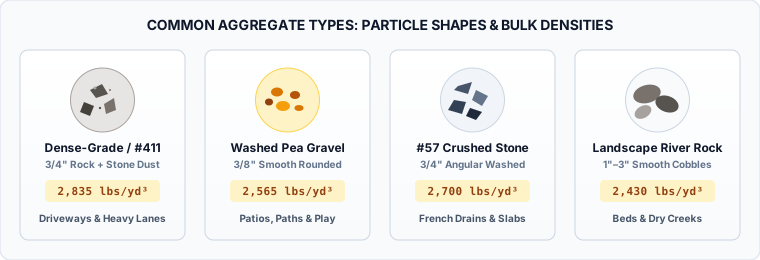
Because quarries sell bulk materials on certified truck weight scales, ordering by the ton is standard in commercial hauling. However, landscape supply yards often sell by the bucket or scoop (1 cubic yard). The table below details standard industry bulk densities used across our calculators:
| Material Type | Lbs / Cu Yd | Tons / Cu Yd | Lbs / Cu Ft |
|---|---|---|---|
| General Construction Gravel | 2,700 | 1.35 | 100 |
| Driveway Gravel (Dense-Grade / Item #4) | 2,835 | 1.42 | 105 |
| Pea Gravel (Washed 3/8" Round) | 2,565 | 1.28 | 95 |
| Crushed Stone (#57 Clean Angular) | 2,700 | 1.35 | 100 |
| Landscape River Rock (1"–3") | 2,430 | 1.22 | 90 |
| Road Base (Crusher Run / ABC) | 2,970 | 1.49 | 110 |
- Measure Dimensions: Length = 50 ft, Width = 12 ft, Desired Compacted Depth = 4 inches.
- Calculate Area: 50 ft × 12 ft = 600 sq ft.
- Convert Depth to Feet: 4 inches ÷ 12 = 0.3333 ft.
- Calculate Cubic Feet: 600 sq ft × 0.3333 ft = 200 cu ft.
- Convert to Cubic Yards: 200 cu ft ÷ 27 = 7.41 cubic yards.
- Apply 10% Ordering Adjustment: 7.41 yd³ × 1.10 = 8.15 cubic yards (+0.74 yd³ allowance).
- Calculate Weight (Dense-Grade @ ~1.42 tons/yd³): 8.15 yd³ × 1.4175 tons/yd³ ≈ 11.55 tons (or 8.15 × 1.42 ≈ 11.57 tons / 23,100 lbs).
Frequently Asked Questions
On average, one cubic yard of standard gravel weighs approximately 1.35 to 1.45 US short tons (2,700 to 2,900 lbs). However, weight varies with stone size and moisture. Denser stone blends with stone dust (like crusher run) weigh nearly 1.5 tons per yard, while dry washed river rock weighs around 1.2 to 1.25 tons per yard.
An ordering adjustment can help account for material waste, measurement variation, uneven surfaces, and/or expected settlement. Actual requirements vary by material and site conditions. Ordering only the geometric quantity can leave a project short because of material waste, uneven surfaces, measurement variation, and settlement.
Driveway aggregate depth depends on the subgrade, climate, drainage, expected traffic, material specification, and local practice. A common approach is to use multiple aggregate layers, with total thickness determined by site conditions and the materials being used (for example, a common approach uses 4 to 6 inches of compacted aggregate over a suitable subgrade). For foot-traffic garden paths and patios using pea gravel, a depth of 2.5 to 3 inches is commonly preferred to help prevent sinking underfoot.
A standard tandem-axle dump truck typically delivers 10 to 14 tons (roughly 7 to 10 cubic yards). Tri-axle dump trucks carry 16 to 22 tons (12 to 15 cubic yards). Actual payload and volume vary by truck configuration, material density, and local weight restrictions.