How the Gravel Calculator Works
When ordering gravel from a quarry or landscape depot, you will encounter two different pricing units: cubic yards (volume) and tons (weight). Our gravel calculator simplifies this process by executing a two-stage calculation: first computing the exact physical space your project occupies, and second, converting that volume into weight based on the bulk density of your chosen stone.
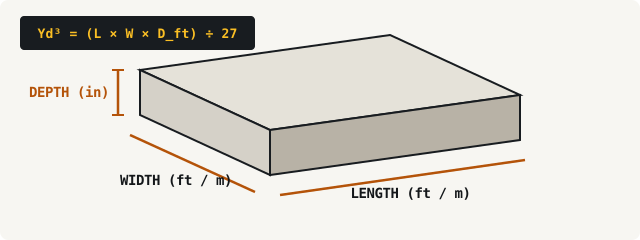
2. Depth in Feet = Depth (inches) ÷ 12
3. Volume (cu ft) = Area (sq ft) × Depth in Feet
4. Volume (cu yd) = Volume (cu ft) ÷ 27
5. Weight (lbs) = Volume (cu yd) × Bulk Density (lbs/yd³)
6. Total Tons = Weight (lbs) ÷ 2,000 (US Short Tons)
Step-by-Step Example Calculation
- Calculate Area: 30 ft × 12 ft = 360 square feet.
- Convert Depth: 4 inches ÷ 12 = 0.333 feet (1/3 ft).
- Find Cubic Feet: 360 sq ft × 0.3333 ft = 120 cubic feet.
- Convert to Cubic Yards: 120 cu ft ÷ 27 = 4.44 cubic yards.
- Apply 10% Ordering Adjustment: 4.44 yd³ × 1.10 = 4.89 recommended cubic yards (+0.44 yd³ allowance).
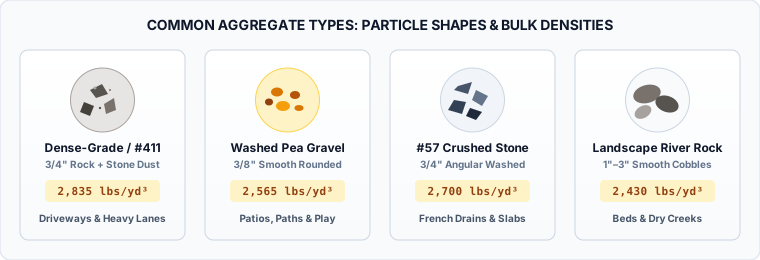
- Convert to Weight (General Gravel @ 2,700 lb/yd³ / 1.35 tons/yd³): 4.89 yd³ × 1.35 tons/yd³ ≈ 6.60 tons (13,200 lbs).
- Bag Equivalent: 13,200 lbs ÷ 50 lbs = 264 bags.
Practical Contractor Guidance for Gravel Installation
Installing gravel is straightforward, but achieving a durable, rut-resistant surface requires proper sub-grade preparation:
- Excavation & Weed Barrier: Always scrape away organic topsoil and grass down to firm sub-soil. Lay heavy-duty woven geotextile fabric beneath your gravel to prevent stone from sinking into clay and to suppress perennial weeds.
- Depth Guidelines by Application:
- Garden Walkways: 2.5" to 3" depth. Walking on gravel deeper than 3 inches feels like wading through dry beach sand.
- Patio & Shed Pads: 4" depth. Provides sufficient stability for garden sheds and outdoor furniture.
- Vehicle Driveways: 4" to 6" surface gravel over a compacted 6" road base sub-layer.
- Edging Restraints: Loose gravel spreads horizontally under foot and tire traffic. Install treated timber, steel, or commercial poly edging flush with your grade to hold stones in place.
Why Factoring in an Ordering Adjustment is Crucial
When bulk stone is placed and spread, it settles into subgrade irregularities and compacts under foot or vehicle weight. Actual settlement and compaction vary with the material, moisture content, subgrade, equipment and installation method. Additionally, a fraction of material is typically displaced along edges or pressed into softer underlying soil.
The ordering adjustment is an estimate intended to account for material waste, measurement variation, uneven surfaces, and/or expected settlement. Actual requirements vary by material and site conditions. For compacted aggregate, follow the recommendation of your supplier or contractor.
Understanding Gravel Costs and Bulk Pricing
Gravel is one of the most cost-effective ground covers available, but pricing models vary:
- Quarry Direct vs. Landscape Depot: Quarries sell crushed stone by certified scale weight (price per ton, illustrative range $25 to $55/ton). Retail depots often sell by the cubic yard bucket ($45 to $75/yd³).
- Delivery & Minimum Loads: Hauling represents a substantial portion of total project cost. Dump truck operators often charge a delivery fee (illustrative range $75 to $150) plus mileage, often with 5-ton to 10-ton minimums. Ordering slightly extra on your first delivery is significantly cheaper than scheduling a second truck for a single missing ton.
Example pricing only. Actual prices vary significantly by location, supplier, material, quantity, delivery distance, equipment and market conditions.