
How Driveway Gravel Is Engineered and Calculated
Unlike pedestrian garden paths, driveways must support vehicle loads between 4,000 lbs (passenger cars) and 40,000+ lbs (delivery trucks and emergency vehicles). To withstand these wheel loads without rutting or washing away during heavy rain, contractors use dense-grade aggregate (such as #411, Item #4, Crusher Run, or Quarry Process).
Dense-grade driveway gravel blends angular 3/4" crushed stone with fine stone dust. When placed, moistened, and rolled, the fines fill void spaces between the larger aggregates, helping form a tight, relatively stable driving surface. Because dense-graded aggregate compacts under rollers and vehicle traffic, an ordering adjustment (typically 10% to 15%) is commonly recommended to achieve the intended finished depth.
2. Depth in Feet = Thickness (inches) ÷ 12
3. Base Geometric Volume (cu yd) = [Area × Depth in Feet] ÷ 27
4. Recommended Volume (cu yd) = Base Volume × (1 + Ordering Adjustment % ÷ 100)
5. Estimated Total Tons = Recommended Volume × Bulk Density (tons/yd³)
Worked Example: Double-Car Driveway Resurfacing
- Calculate Area: 50 ft × 20 ft = 1,000 square feet.
- Convert Depth: 3 inches ÷ 12 = 0.25 feet.
- Calculate Base Volume: 1,000 sq ft × 0.25 ft = 250 cubic feet ÷ 27 = 9.26 cubic yards.
- Ordering Adjustment (10%): 9.26 yd³ × 1.10 = 10.19 cubic yards (+0.93 yd³ allowance).
- Estimated Weight (@ ~1.42 tons/yd³): 10.19 yd³ × 1.4175 tons/yd³ (2,835 lb/yd³) ≈ 14.44 tons (or 10.19 × 1.42 ≈ 14.47 tons / 28,940 lbs).
- Delivery Planning: An order of approximately 14.5 tons can typically be accommodated in a standard tandem or tri-axle dump truck (subject to local hauler capacity limits).
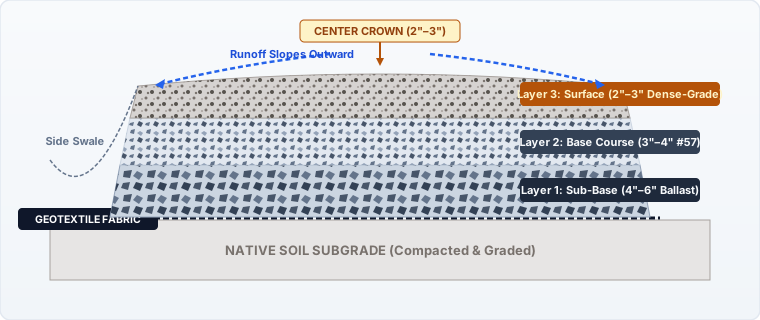
The 3 Essential Layers of a Long-Lasting Gravel Driveway
If you are building a new gravel driveway from raw ground rather than merely adding stone to an existing lane, do not pour 8 inches of small gravel directly onto dirt. A proper gravel driveway consists of three distinct layers:
- Layer 1: Sub-Base Foundation (4"–6" of #3 or #4 Ballast Stone): Large fist-sized fractured stone (1.5" to 3") pressed into native soil over non-woven geotextile fabric. This layer distributes vehicle weight and prevents the driveway from sinking into mud during spring thaws.
- Layer 2: Base Course (3"–4" of #57 Angular Stone): Clean, fractured 3/4" rock without dust. This layer provides crucial lateral stability and allows rainwater to drain freely away from the sub-grade.
- Layer 3: Wearing Surface (2"–3" of Dense-Grade / #411 Stone): The top visible layer containing 3/4" stone mixed with limestone fines. Compacted with a vibratory roller to create a tight, drivable surface crowned at the centerline.
Crowning and Drainage: Protecting Your Investment
Water is the primary enemy of gravel driveways. A completely flat gravel driveway will develop standing puddles, which soften the base and form deep potholes under vehicle tires.
Always grade your driveway with a center crown: the center of the driveway should be 2 to 3 inches higher than the outer edges, sloping outward at roughly 1/2 inch of drop per foot of width. This sheds storm runoff into side swales before it can pool and erode your stone.