
5/8" Minus Crushed Gravel (also called 5/8" Crushed Surfacing Top Course / CSTC in WA, OR, and ID) consists of 100% fractured basalt or granite screened from 5/8 inch (16 mm) down to stone dust fines. It weighs 2,920 lbs per cubic yard (1.46 US tons/yd³) and is the premier top-course aggregate for driveways, paver patios, and compacted walkways.
Specification & Reference Table: 5/8" Minus Crushed Gravel
| Layer Type | Western Quarry Grade | Recommended Depth | Tons per 1,000 Sq Ft (+15%) |
|---|---|---|---|
| Bottom Sub-Base Course | 1-1/4" Minus or 3" Minus Crushed | 4" – 6" Compacted | 21.0 – 31.5 Tons |
| Top Wearing Surface | 5/8" Minus Crushed Rock (CSTC) | 2" – 3" Compacted | 10.4 – 15.6 Tons |
| Paver Patio Base | 5/8" Minus Crushed Rock | 4" Compacted | 20.8 Tons |
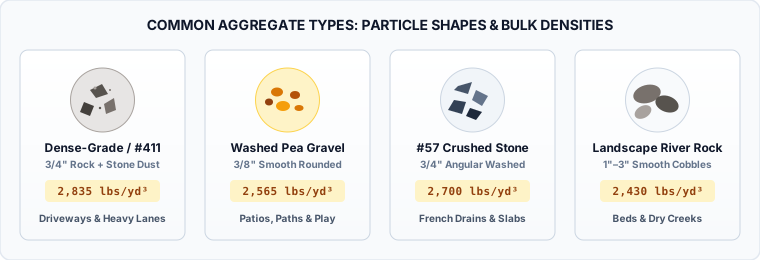
Bulk Density & Moisture Physics (5/8" Minus Crushed Gravel): When ordering quarry materials or scheduling dump truck dispatch, understanding the difference between loose cubic yard volume and certified scale tonnage is critical. Standard open-graded crushed stone (such as washed ASTM #57, #67, or #8 stone) maintains a loose bulk density of 2,640 to 2,720 lbs per cubic yard (1.32 to 1.36 US short tons/yd³) with a 38%–40% void ratio. Dense-graded road bases containing stone dust fines (such as #411 Crusher Run, #304 Limestone, Item #4, or Caltrans Class 2 AB) pack tighter and weigh 2,920 to 3,000 lbs per cubic yard (1.46 to 1.50 US short tons/yd³). After stockpile rain events, retained surface moisture can increase scale ticket weight by 5% to 12% on stone and up to 20% on sand or screened topsoil.
Loose vs. Compacted Volume (12%–18% Shrinkage Factor): Every cubic yard table measures in-place geometric volume before mechanical compaction. Once you spread aggregate and make 3 to 4 passes with a 5,000-lb vibratory plate compactor or smooth-drum roller, angular particles rotate into void spaces and the lift thickness compresses by 12% to 18% (and up to 20% for Decomposed Granite or Crusher Run). Regional mineralogy also shifts yield: dolomitic limestone and granite average 1.35–1.48 tons/yd³, dense Pacific Northwest basalt reaches 1.52 tons/yd³, and porous volcanic scoria or lava rock weighs just 0.65–0.78 tons/yd³.
Step-by-Step Tonnage, Volume & Cost Calculation
To eliminate mid-project material shortages or paying a second dump truck mobilization fee, professional estimators calculate takeoff quantities for 5/8" Minus Crushed Gravel using three standardized civil engineering formulas:
1. Cubic Yards from Inches:
Area (sq ft) × Compacted Depth (in) ÷ 324 = Net Cubic Yards (yd³)2. US Short Tons Conversion:
Net Cubic Yards × Bulk Density (1.35 to 1.48 tons/yd³) × 1.12 Compaction Factor = Order Tons3. Total Delivered Price:
(Order Tons × Quarry Price/Ton) + (Number of Truckloads × Haul Fee) = Total Delivered Cost
Worked Job-Site Example (600 Sq Ft Project @ 4" Compacted Depth): Suppose you are preparing a 12 ft × 50 ft (600 sq ft) area at a 4-inch compacted depth. Using the volume formula, 600 sq ft × 4 in ÷ 324 = 7.41 net cubic yards (200 cubic feet). Multiplying 7.41 yd³ × 1.42 tons/yd³ yields 10.52 net tons. Adding a 12% vibratory compaction and grading buffer brings your quarry order to 11.78 US short tons (8.30 cubic yards)—which fits cleanly inside a single 15-ton tandem-axle dump truck load. At a 2026 benchmark rate of $36/ton material ($424) plus a $155 local haul fee, total delivered job cost is $579 ($0.97 per sq ft).
Bulk Dump Truck Delivery vs. Buying 50-Lb (0.5 Cu Ft) Bags: Hardware store gravel, sand, and stone are sold in 50-lb bags containing 0.50 cubic feet. Because 1 cubic yard equals 27 cubic feet, it takes 54 bags to equal 1 cubic yard (and 40 bags to equal 1 US short ton). For the 8.30-cubic-yard example above, buying bagged stone would require 448 individual 50-lb bags costing $2,240+ at $5.00/bag—nearly 4× more expensive than a single $579 bulk dump truck drop. Bulk delivery beats bagged material on every project exceeding 1.5 tons (60 bags).
Material Grade Comparison & Contractor Installation Best Practices
Selecting the right aggregate gradation and sub-base assembly determines whether your installation stays laser-level for 20 years or ruts and pumps mud after the first freeze-thaw season. Compare the four primary contractor aggregate classes below:
| Aggregate Class & Grade | Bulk Density | Compaction Buffer | Optimal Lift Depth & Geotextile Pairing | Primary Engineering Application |
|---|---|---|---|---|
| Dense-Graded Base (#411, #304, Item #4, Class 2 AB) | 1.48 – 1.50 T/yd³ | +15% | 4"–6" lifts over woven stabilization fabric | Driveway structural base, paver sub-base, parking lots |
| Open-Graded Washed Stone (ASTM #57, #67, #4) | 1.32 – 1.36 T/yd³ | +10% | 3"–4" layer wrapped in 4 oz non-woven fabric | French drains, shed pads, retaining wall backfill, concrete slabs |
| Fine Screed & Pathway Stone (#8, #89, Pea Gravel, DG) | 1.32 – 1.46 T/yd³ | +12% – 18% | 1"–3" compacted or screeded top lift | Patio walkways, permeable paver bedding, xeriscape beds |
| Heavy Sub-Base & Armor (#1, #2, #3 Ballast, Riprap) | 1.28 – 1.30 T/yd³ | +10% | 6"–12" lift over heavy woven geotextile | Soft clay stabilization, construction entrances, ditch erosion armor |
- Sub-Base Excavation & Organic Stripping: Always strip 100% of sod, roots, and spongy black topsoil down to firm mineral subsoil. Topsoil decomposes and holds water, causing gravel layers to sink unevenly.
- Woven vs. Non-Woven Geotextile Fabric Selection: Roll out high-tensile woven stabilization geotextile (200–300 lb grab tensile) under driveways, parking pads, and road bases to separate clay from crushed stone. Use 4 oz to 6 oz needle-punched non-woven drainage fabric inside French drain trenches and behind retaining walls where high water permittivity is required.
- Compaction in 4-Inch Maximum Lifts: Never dump 8 to 12 inches of Crusher Run or road base and attempt to compact it in a single pass. Spread and compact in 3-inch to 4-inch lifts at optimum moisture content (lightly misted with a garden hose so stone dust binds tightly without turning soupy).
- Positive Drainage Slope & Edge Restraint: Grade driveways with a 2% to 3% center crown (1/4" to 3/8" drop per foot toward side ditches) and pitch patios 1/8" to 1/4" per foot away from building foundations. Secure decorative pea gravel or decomposed granite with steel, aluminum, or timber perimeter edging.
- Common Ordering Mistakes to Avoid: Never order washed #57 stone for a steep sloped driveway without a compacted #304/#411 base (clean stone rolls on grades over 6%), never exceed half-ton pickup axle payload limits (1 cubic yard = 2,700 lbs), and always verify overhead tree/wire clearance (24–28 ft raised bed height) before dump truck arrival.
Calculate Exact Cubic Yards, Tons, 50-Lb Bags & Cost
Open our specialized calculator to compute exact material volume, weight, and delivered truckloads for your project.
Frequently Asked Questions
How do you calculate exact tons and cubic yards for 5/8" Minus Crushed Gravel?
Area (sq ft) × Depth (in) ÷ 324 = Cubic Yards. Multiply cubic yards by the material bulk density (1.35 tons/yd³ for washed #57 or pea stone; 1.48 tons/yd³ for Crusher Run or road base) and add a 10% to 15% compaction buffer.