
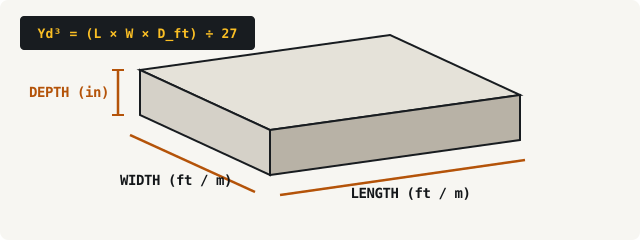
A 12 ft × 120 ft driveway (1,440 sq ft) requires 27.77 US short tons (19.56 cubic yards) of dense-graded driveway gravel at a standard 4-inch depth (including a 10% compaction allowance). For a 2-inch surface refresh, order 13.88 tons (9.78 yd³); for a 6-inch heavy-duty base, order 41.65 tons (29.33 yd³).
Specification & Reference Table: Step-by-Step Volume & Tonnage Math for a 12 ft × 120 ft Driveway
Designing or resurfacing a 12-foot wide by 120-foot long (1,440 sq ft) 12x120 country driveway starts with converting surface area and compacted lift thickness into cubic yards, then multiplying by the quarry bulk density of your chosen stone:
2. Net Volume (cu ft) = 1,440 sq ft × (4 in ÷ 12) = 480.00 cu ft
3. Net Volume (cu yd) = 480.00 cu ft ÷ 27 = 17.78 yd³
4. Net Quarry Weight = 17.78 yd³ × 1.42 tons/yd³ = 25.24 tons
5. Recommended Order (+10% Compaction Buffer) = 27.77 Tons (19.56 Cubic Yards)
12×120 Driveway Gravel Tonnage, Cubic Yards & Truckload Table (By Depth)
Use the lookup table below to compare material requirements for a 12' × 120' driveway across six common excavation and resurfacing depths (using 1.42 tons/yd³ dense-graded driveway stone with a 10% compaction allowance):
| Compacted Depth | Primary Application | Net Cubic Yards | Order Cubic Yards (+10%) | Order Tons (+10%) | Tandem Truck Loads (15T) |
|---|---|---|---|---|---|
| 2 Inches (0.17 ft) | Surface Top-Dress / Refresh (#57 or #8 Stone) | 8.89 yd³ | 9.78 yd³ | 13.88 tons | 1 load(s) |
| 3 Inches (0.25 ft) | Light Resurfacing / Wearing Course | 13.33 yd³ | 14.67 yd³ | 20.83 tons | 2 load(s) |
| 4 Inches (0.33 ft) | Standard Compacted Lift (Crusher Run / #411) | 17.78 yd³ | 19.56 yd³ | 27.77 tons | 2 load(s) |
| 6 Inches (0.50 ft) | Heavy-Duty Structural Base (Pickup & SUV Traffic) | 26.67 yd³ | 29.33 yd³ | 41.65 tons | 3 load(s) |
| 8 Inches (0.67 ft) | 2-Layer New Driveway (4" Sub-Base + 4" Top) | 35.56 yd³ | 39.11 yd³ | 55.54 tons | 4 load(s) |
| 12 Inches (1.00 ft) | Full 3-Layer Clay/Frost Excavation (6"+4"+2") | 53.33 yd³ | 58.67 yd³ | 83.31 tons | 6 load(s) |
Bulk Density & Moisture Physics (a 12x120 Driveway): When ordering quarry materials or scheduling dump truck dispatch, understanding the difference between loose cubic yard volume and certified scale tonnage is critical. Standard open-graded crushed stone (such as washed ASTM #57, #67, or #8 stone) maintains a loose bulk density of 2,640 to 2,720 lbs per cubic yard (1.32 to 1.36 US short tons/yd³) with a 38%–40% void ratio. Dense-graded road bases containing stone dust fines (such as #411 Crusher Run, #304 Limestone, Item #4, or Caltrans Class 2 AB) pack tighter and weigh 2,920 to 3,000 lbs per cubic yard (1.46 to 1.50 US short tons/yd³). After stockpile rain events, retained surface moisture can increase scale ticket weight by 5% to 12% on stone and up to 20% on sand or screened topsoil.
Loose vs. Compacted Volume (12%–18% Shrinkage Factor): Every cubic yard table measures in-place geometric volume before mechanical compaction. Once you spread aggregate and make 3 to 4 passes with a 5,000-lb vibratory plate compactor or smooth-drum roller, angular particles rotate into void spaces and the lift thickness compresses by 12% to 18% (and up to 20% for Decomposed Granite or Crusher Run). Regional mineralogy also shifts yield: dolomitic limestone and granite average 1.35–1.48 tons/yd³, dense Pacific Northwest basalt reaches 1.52 tons/yd³, and porous volcanic scoria or lava rock weighs just 0.65–0.78 tons/yd³.
Material Grade Comparison & Contractor Installation Best Practices
Selecting the right aggregate gradation and sub-base assembly determines whether your installation stays laser-level for 20 years or ruts and pumps mud after the first freeze-thaw season. Compare the four primary contractor aggregate classes below:
| Aggregate Class & Grade | Bulk Density | Compaction Buffer | Optimal Lift Depth & Geotextile Pairing | Primary Engineering Application |
|---|---|---|---|---|
| Dense-Graded Base (#411, #304, Item #4, Class 2 AB) | 1.48 – 1.50 T/yd³ | +15% | 4"–6" lifts over woven stabilization fabric | Driveway structural base, paver sub-base, parking lots |
| Open-Graded Washed Stone (ASTM #57, #67, #4) | 1.32 – 1.36 T/yd³ | +10% | 3"–4" layer wrapped in 4 oz non-woven fabric | French drains, shed pads, retaining wall backfill, concrete slabs |
| Fine Screed & Pathway Stone (#8, #89, Pea Gravel, DG) | 1.32 – 1.46 T/yd³ | +12% – 18% | 1"–3" compacted or screeded top lift | Patio walkways, permeable paver bedding, xeriscape beds |
| Heavy Sub-Base & Armor (#1, #2, #3 Ballast, Riprap) | 1.28 – 1.30 T/yd³ | +10% | 6"–12" lift over heavy woven geotextile | Soft clay stabilization, construction entrances, ditch erosion armor |
- Sub-Base Excavation & Organic Stripping: Always strip 100% of sod, roots, and spongy black topsoil down to firm mineral subsoil. Topsoil decomposes and holds water, causing gravel layers to sink unevenly.
- Woven vs. Non-Woven Geotextile Fabric Selection: Roll out high-tensile woven stabilization geotextile (200–300 lb grab tensile) under driveways, parking pads, and road bases to separate clay from crushed stone. Use 4 oz to 6 oz needle-punched non-woven drainage fabric inside French drain trenches and behind retaining walls where high water permittivity is required.
- Compaction in 4-Inch Maximum Lifts: Never dump 8 to 12 inches of Crusher Run or road base and attempt to compact it in a single pass. Spread and compact in 3-inch to 4-inch lifts at optimum moisture content (lightly misted with a garden hose so stone dust binds tightly without turning soupy).
- Positive Drainage Slope & Edge Restraint: Grade driveways with a 2% to 3% center crown (1/4" to 3/8" drop per foot toward side ditches) and pitch patios 1/8" to 1/4" per foot away from building foundations. Secure decorative pea gravel or decomposed granite with steel, aluminum, or timber perimeter edging.
- Common Ordering Mistakes to Avoid: Never order washed #57 stone for a steep sloped driveway without a compacted #304/#411 base (clean stone rolls on grades over 6%), never exceed half-ton pickup axle payload limits (1 cubic yard = 2,700 lbs), and always verify overhead tree/wire clearance (24–28 ft raised bed height) before dump truck arrival.
Adjust Stone Type, Compaction Buffer & Local Quarry Price
Open our interactive Driveway Gravel Calculator to test #57 stone, Crusher Run, or Asphalt Millings for your 1,440 sq ft project.
Recommended 3-Layer Stone Split for a Brand-New 12×120 Driveway
If you are stripping topsoil down to firm subsoil to build a brand-new 12 ft × 120 ft driveway (8 inches total structural thickness), do not order a single grade of stone. Split your quarry order across two or three interlocking gradations:
- Geotextile Underlayment: Roll out 1,656 sq ft of woven stabilization fabric (with 12-inch overlaps) so clay mud cannot pump upward into your stone.
- Bottom Sub-Base Lift (4" Depth): Order 27.77 tons of coarse #3 Crushed Stone (1.5"–2.5") or heavy Crusher Run (#411 / Item #4) compacted with a vibratory roller.
- Middle Drainage & Lock Lift (2" Depth): Order 13.88 tons of clean angular ASTM #57 Crushed Stone.
- Top Wearing Course (2" Depth): Order 13.88 tons of 3/4"-minus Crusher Run with stone dust fines graded with a 2% center crown so rainwater sheets off toward the ditches.
Frequently Asked Questions
How many dump truck loads of gravel does a 12x120 driveway take?
How much does gravel cost for a 12x120 driveway in 2026?
How do you calculate exact tons and cubic yards for a 12x120 Driveway?
Area (sq ft) × Depth (in) ÷ 324 = Cubic Yards. Multiply cubic yards by the material bulk density (1.35 tons/yd³ for washed #57 or pea stone; 1.48 tons/yd³ for Crusher Run or road base) and add a 10% to 15% compaction buffer.